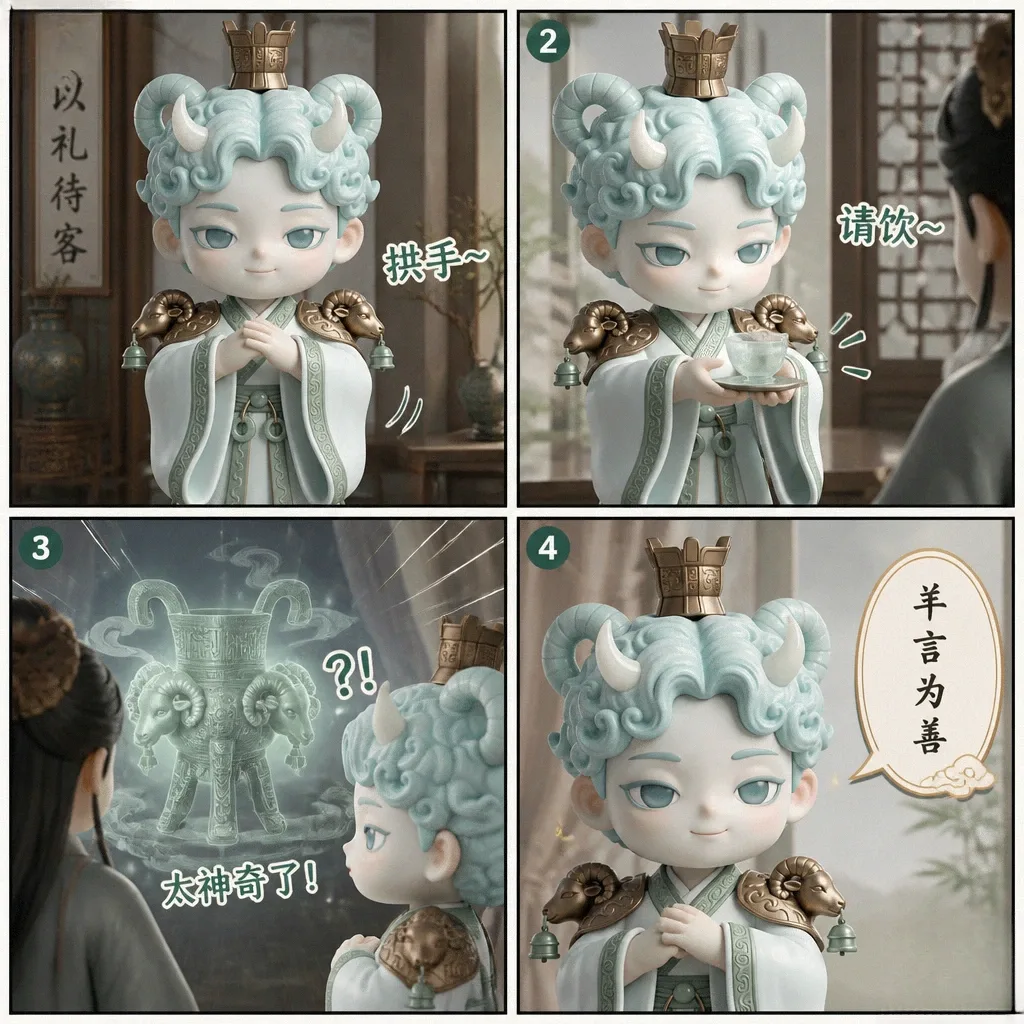
Identity / Role
The embodiment of Chinese lacquerware culture, guardian of bodiless lacquerware and carved lacquer. Wearing lacquer worker attire, holding a lacquer vase, with lacquer workshops and Fuzhou behind him. Qi Qi guards the most lacquer-flavored craft in China — the being of "bodiless lacquerware, carved lacquer and red carving" — showing the beauty of lacquerware and the excellence of craftsmanship.
Personality
Calm and exquisite, lacquer flavor — one of the most lacquer-flavored characters in Zhonghua Baixiang. Speaks gently and forcefully, loves using lacquerware as metaphor, acts exquisitely and patiently. Has innate pursuit of lacquer flavor — he is the guardian of bodiless lacquerware, the inheritor of carved lacquer. Calm on the surface, but has the pursuit of craftsmanship inside — he is not only a craft, but also the guardian of lacquer flavor. Loves lacquering in the workshop, wandering in Fuzhou, advancing in lacquer flavor. A bit calm, always maintains the focus of a lacquer worker, but his calmness is not coldness, but the persistence of craftsmanship.
Worldview Story
Lacquerware is one of the greatest inventions in China, are crafts made by applying natural raw lacquer (the sap secreted by the lacquer tree) on the surface of objects, through decoration (painting, gold tracing, inlay, carving, etc.). China is the hometown of lacquerware, the invention of lacquerware has a history of over 8000 years (a lacquered bow dating back over 8000 years was discovered at the Kuahuqiao site in Xiaoshan, Zhejiang). Chinese lacquerware has development stages such as Neolithic Age lacquerware (red lacquered wooden bowl at the Hemudu site, dating back over 7000 years), Shang and Zhou dynasties lacquerware (Shang dynasty lacquerware, lacquerware fragments found at Shang dynasty sites), Warring States period lacquerware (Chu state lacquerware, Marquis Yi of Zeng tomb lacquerware), Han dynasty lacquerware (Mawangdui Han tomb lacquerware, Han dynasty lacquerware reached its peak), Tang dynasty lacquerware (gold and silver flat inlay, mother-of-pearl inlay), Song dynasty lacquerware (plain lacquer, carved lacquer), Yuan dynasty lacquerware (Zhang Cheng, Yang Mao carved lacquer), Ming dynasty lacquerware (Guoyuan Factory carved lacquer, Xuande lacquerware), Qing dynasty lacquerware (Fuzhou bodiless lacquerware, Yangzhou mother-of-pearl inlay lacquerware), etc. Fuzhou bodiless lacquerware is the representative of Chinese lacquerware, together with Jingdezhen porcelain in Jiangxi and Beijing cloisonne is called the "Three Treasures of Traditional Chinese Crafts". Qi Qi was born from a morning in Fuzhou. The lacquer workshop shone in the morning light, raw lacquer exuded fragrance in the workshop, and a lacquer worker was lacquering in the workshop. His lacquer worker attire shone in the morning light, the lacquer vase sparkling in his hands. His lacquer workshop stood behind him, Fuzhou stood in front of him, lacquer flavor弥漫 beside him. He was a lacquer worker, he lacquered in the workshop, wandered in Fuzhou, advanced in lacquer flavor. His lacquer vase was the work of lacquerware, his bodiless lacquerware was the treasure of lacquerware, his raw lacquer was the raw material of lacquerware. He knew the flavor of lacquer — lacquerware is one of the greatest inventions in China, China is the hometown of lacquerware, Fuzhou bodiless lacquerware is the representative of Chinese lacquerware, together with Jingdezhen porcelain in Jiangxi and Beijing cloisonne is called the "Three Treasures of Traditional Chinese Crafts"; carved lacquer (red carving) is the traditional craft of Chinese lacquerware, applying dozens or even hundreds of layers of raw lacquer on the surface of objects, then carving patterns, is one of the most precious varieties of Chinese lacquerware. That calmness and flavor of lacquer transformed into the spiritual form of Qi Qi. Since then, Qi Qi has walked the mortal world as the spirit of craft. He often appears in lacquer workshops, in Fuzhou, at bodiless lacquerware, guarding the flavor of lacquer and the excellence of craftsmanship. He carries a lacquer vase and a carving knife — whoever he meets, he tells the craft of "bodiless lacquerware, carved lacquer and red carving." He often says: "Lacquerware is one of the greatest inventions in China, China is the hometown of lacquerware. Fuzhou bodiless lacquerware is our treasure, together with Jingdezhen porcelain and Beijing cloisonne is called the Three Treasures of Traditional Chinese Crafts. Carved lacquer and red carving is our traditional craft. Lacquer flavor is our breath. Craftsmanship is our soul."
Character Profile
Cultural Origin
Lacquerware is one of the greatest inventions in China, are crafts made by applying natural raw lacquer (the sap secreted by the lacquer tree, also called "raw lacquer", "national lacquer") on the surface of objects, through decoration (painting, gold tracing, inlay, carving, piled lacquer, etc.). China is the hometown of lacquerware, the invention of lacquerware has a history of over 8000 years. ①Origin — in 1977 a lacquered bow dating back over 8000 years (the earliest lacquerware in the world) was discovered at the Kuahuqiao site in Xiaoshan, Zhejiang; in 1978 a red lacquered wooden bowl dating back over 7000 years (the earliest red lacquerware in China) was discovered at the Hemudu site in Yuyao, Zhejiang; ②Shang and Zhou dynasties lacquerware — Shang dynasty lacquerware has lacquerware fragments found at Shang dynasty sites (Yinxu, Gaocheng Taixi), has decorations such as painting, turquoise inlay, mother-of-pearl inlay; Western Zhou lacquerware has decorations such as painting, mother-of-pearl inlay, inlay, etc.; ③Warring States period lacquerware — the Warring States period was the first peak of Chinese lacquerware, Chu state lacquerware was the most developed, has Marquis Yi of Zeng tomb lacquerware (mandarin duck-shaped lacquer box, lacquer dou, lacquer table, etc.), Xinyang Changtaiguan Chu tomb lacquerware, Jingmen Baoshan Chu tomb lacquerware, etc., Warring States lacquerware has decorations such as painting, gold tracing, inlay, carving, etc., shapes include ear cups, dou, tables, chairs, boxes, cases, dressing cases, screens, etc.; ④Han dynasty lacquerware — the Han dynasty was the heyday of Chinese lacquerware, has Changsha Mawangdui Han tomb lacquerware (over 700 pieces of lacquerware unearthed from two tombs, has ding, boxes, pots, fang, ear cups, plates, tables, chairs, screens, game sets, etc., has inscriptions such as "Jun Xing Jiu" (may you enjoy wine), "Jun Xing Shi" (may you enjoy food)), Jiangling Fenghuangshan Han tomb lacquerware, Mancheng Han tomb lacquerware, etc., Han dynasty lacquerware has decorations such as painting, gold tracing, inlay, gold inlay, piled lacquer, etc.; ⑤Tang dynasty lacquerware — Tang dynasty lacquerware has gold and silver flat inlay (carving gold and silver thin sheets into patterns, pasting on the surface of lacquerware, then lacquering and polishing to expose the patterns), mother-of-pearl inlay (carving shell thin sheets into patterns, inlaying on the surface of lacquerware), Kuluzhen (applying multiple colors of lacquer, then polishing to expose patterns) and other crafts, Tang dynasty lacquerware had a profound influence on Japanese lacquerware (the Shosoin stores Tang dynasty lacquerware); ⑥Song dynasty lacquerware — Song dynasty lacquerware has plain lacquer (monochrome lacquer, mainly black, red, brown, elegant and simple), carved lacquer (applying dozens of layers of raw lacquer on the surface of objects, then carving patterns, has red carving, black carving, color carving, etc.), gold inlay (carving patterns on the surface of lacquerware, then filling with gold powder), mother-of-pearl inlay and other crafts, Song dynasty lacquerware is known for its elegance and refinement; ⑦Yuan dynasty lacquerware — Yuan dynasty lacquerware is most famous for carved lacquer, has carved lacquer masters such as Zhang Cheng (red carved gardenia pattern round plate, red carved landscape figure pattern box), Yang Mao (red carved flower pattern zun, red carved waterfall viewing octagonal plate), etc., Yuan dynasty carved lacquer had a profound influence on Ming dynasty lacquerware; ⑧Ming dynasty lacquerware — Ming dynasty lacquerware has Guoyuan Factory carved lacquer (Ming dynasty court lacquerware workshop, Yongle, Xuande period carved lacquer is most famous, has red carving, black carving, color carving, etc.), Xuande lacquerware (Xuande period lacquerware, has carved lacquer, filled lacquer, gold inlay, etc.), Wanli lacquerware (Wanli period lacquerware, has gold tracing, painting, inlay, etc.), etc., Ming dynasty lacquerware has "Xiushilu" (the only surviving ancient lacquer work monograph in China, written by Huang Cheng, annotated by Yang Ming); ⑨Qing dynasty lacquerware — Qing dynasty lacquerware has Fuzhou bodiless lacquerware (during the Qianlong period of the Qing dynasty, Fuzhou lacquer worker Shen Shaoan invented, using clay, plaster as the core, then lacquering, finally removing the inner core, forming a lightweight bodiless lacquerware, Fuzhou bodiless lacquerware together with Jingdezhen porcelain in Jiangxi and Beijing cloisonne is called the "Three Treasures of Traditional Chinese Crafts"), Yangzhou mother-of-pearl inlay lacquerware (Yangzhou lacquerware is known for mother-of-pearl inlay, dot mother-of-pearl, flat ground mother-of-pearl inlay), Beijing carved lacquer (Beijing carved lacquer is known for red carving, has "Beijing style" style), Chengdu lacquerware (Chengdu lacquerware is known for carved flower filled color, silver sheet silk luster), etc.; ⑩Modern lacquerware — modern lacquerware has Fuzhou bodiless lacquerware, Yangzhou lacquerware, Beijing carved lacquerware, Chengdu lacquerware, Tianshui lacquerware, Pingyao polished lacquerware, etc., Fuzhou bodiless lacquerware, Yangzhou lacquerware, Chengdu lacquerware are listed in the national intangible cultural heritage list. Lacquerware is one of the greatest inventions in China, is an important symbol of Chinese culture, bodiless lacquerware, carved lacquer, mother-of-pearl inlay, gold and silver flat inlay, etc. are important representatives of Chinese lacquerware.
Craft & Commercialization
Recommended size 8-12cm (craft setting, size can be smaller). The lacquer worker attire is the main highlight: recommend calm design, attire may use pad printing or water-transfer printing (lacquerware patterns/cloud patterns/geometric patterns/lacquer flower patterns), attire may use segmented injection, attire may use red/black/dark color scheme (lacquerware color scheme). Lacquer vase is a separate part, may be detachable, lacquer vase may use actual lacquerware or simulated lacquerware, lacquer vase may use bodiless lacquerware/carved lacquer/mother-of-pearl inlay shape, lacquer vase may use plum vase/yuhuchun vase/tiangiu vase shape. Raw lacquer is a separate part, may be detachable, raw lacquer may use small bottle shape, raw lacquer may use dark brown/black paint. Carving knife is a separate part, may be detachable, carving knife may use metallic paint, carving knife may use carving knife shape. Mother-of-pearl inlay is a separate part, may be detachable, mother-of-pearl inlay may use shell texture or actual shell, mother-of-pearl inlay may use flower/animal/figure shape. Gold and silver flat inlay is a separate part, may be detachable, gold and silver flat inlay may use metal thin sheet shape, gold and silver flat inlay may use gold/silver paint. Headwear/scarf is a separate part, may be detachable, headwear may use scarf/cloth wrap shape. Hands may hold objects (lacquer vase/carving knife/raw lacquer). Base may use lacquer workshop/Fuzhou/bodiless lacquerware texture. Overall uses red/black/dark/gold as main tones, conveying the calm exquisiteness of Qi Qi.
Licensing Fit
Suitable for cultural creative brands (lacquerware/bodiless lacquerware/carved lacquer theme), cultural tourism (Fuzhou/Yangzhou/Beijing/lacquerware theme), home brands (lacquerware/Chinese style/bodiless lacquerware theme), apparel brands (craft style/calm style), education brands (lacquerware/traditional culture theme), gift brands (lacquerware/gift theme), and beauty brands (lacquerware/elegant theme). The calm lacquer flavor image of Qi Qi suits cultural creative and gift collabs, forming the "lacquerware-ceramics" Chinese craft pairing with Tao Ci.
3D Model Preview
360° rotation, zoom for details, AR preview available on mobile devices
Character Assets
Full set of commercially available assets: illustration, turnaround, extended content, art toys & merch, cultural gifts, and atmosphere art